

September 16, 2024
How the Business Process Fabric™ Uses AI for Agile Business Processes
In this blog, we’ll explore use cases that demonstrate how our dual AI approach—Deterministic AI and Generative AI—drives business transformation by predicting change and creating strategic responses to ensure success.
Overview
Artificial intelligence (AI) is transforming the way businesses operate, and at Cognitus, we’re at the forefront of this revolution. Our Business Process Fabric™, an end-to-end business transformation model, seamlessly integrates custom AI with the power of SAP technologies. This model combines the capabilities of SAP Signavio, SAP LeanIX, Datasphere, Data Intelligence, BTP AI, and SAP Analytical Cloud with our AI-based LLMs, data learning models, and Recurrent Neural Networks (RNNs) to drive innovation, enhance enterprise architecture, and optimize processes for businesses across industries.
Deterministic AI vs. Generative AI: A Dual Approach to Transformation
In today’s ever-changing business landscape, organizations need to anticipate and adapt to disruption. This is where AI plays a pivotal role. Deterministic AI and Generative AI, two powerful AI paradigms, offer distinct benefits for business transformation. While deterministic AI excels in prediction and forecasting, generative AI shines in creating innovative solutions to mitigate challenges and capitalize on opportunities.
Let’s learn how deterministic AI and generative AI can work together in real-life scenarios to empower businesses to rapidly adapt and navigate challenges in an evolving economy.
Deterministic AI: Predicting Change
Deterministic AI operates based on predefined rules and fixed algorithms, delivering consistent and reliable outcomes. In business, this approach is valuable for decision-making tasks that rely on historical data to predict future events. Whether it’s forecasting market trends, anticipating supply chain disruptions, or predicting customer behavior, deterministic AI provides actionable insights that help organizations prepare for upcoming changes.
For instance, a manufacturing company might use deterministic AI to model potential supply chain disruptions due to geopolitical tensions or material shortages. The AI analyzes historical data and risk factors to predict the likelihood of disruptions over the next quarter, empowering decision-makers to proactively plan for these challenges.
However, while deterministic AI is great for predicting change, it doesn’t offer solutions for how to respond to those changes.
Generative AI: Creating Strategic Responses
Where deterministic AI predicts what will happen, Generative AI offers solutions for how to respond. By using machine learning models, generative AI can simulate various scenarios and generate strategies for overcoming disruptions. It’s an essential tool for businesses looking to innovate and create strategic roadmaps in response to change.
Take the example of the manufacturing company predicting supply chain disruptions. Generative AI can propose alternative sourcing strategies, optimize logistics, and even suggest partnerships to mitigate risks. By simulating various scenarios, it can recommend shifting production timelines, diversifying suppliers, or adopting just-in-time manufacturing principles, giving businesses multiple options to adapt quickly and efficiently.
Creating a Comprehensive Business Transformation Roadmap
When combined, deterministic and generative AI offer a comprehensive roadmap for business transformation. Consider a retail company that uses AI to navigate shifts in consumer behavior. Here’s how the two work together:
Step 1: Prediction of Change with Deterministic AI
- The company uses deterministic AI to forecast an impending shift in consumer behavior due to changing economic conditions. The model predicts that rising inflation will reduce discretionary spending, leading to decreased sales in certain product categories.
- Deterministic AI calculates potential revenue drops across regions, identifies product lines most at risk, and estimates the impact on overall profitability.
Step 2: Building a Strategic Response with Generative AI
- Armed with these insights, the organization applies generative AI to create a strategic roadmap. Generative AI simulates multiple future scenarios, including potential marketing strategies, diversification of product lines, and adjustments to pricing models.
- The AI might propose launching cost-effective products that cater to a more budget-conscious consumer base, reallocating resources toward essential goods, or developing personalized loyalty programs to retain existing customers.
- These strategies are further refined by simulating their effects across different economic conditions, helping the organization navigate the anticipated change effectively.
This way the AI helps optimize strategies based on multiple scenarios, allowing the organization to adapt proactively.
Want to learn more about AI-driven transformation tools? Join Cognitus, the Diamond Sponsor at the SAP Transformation Excellence Summit from September 16 to 18 in Chicago, IL to learn more about our AI-driven business transformation model and SAP’s latest transformation management tools!
Business Process Fabric™ : AI-Driven Business Transformation in Action
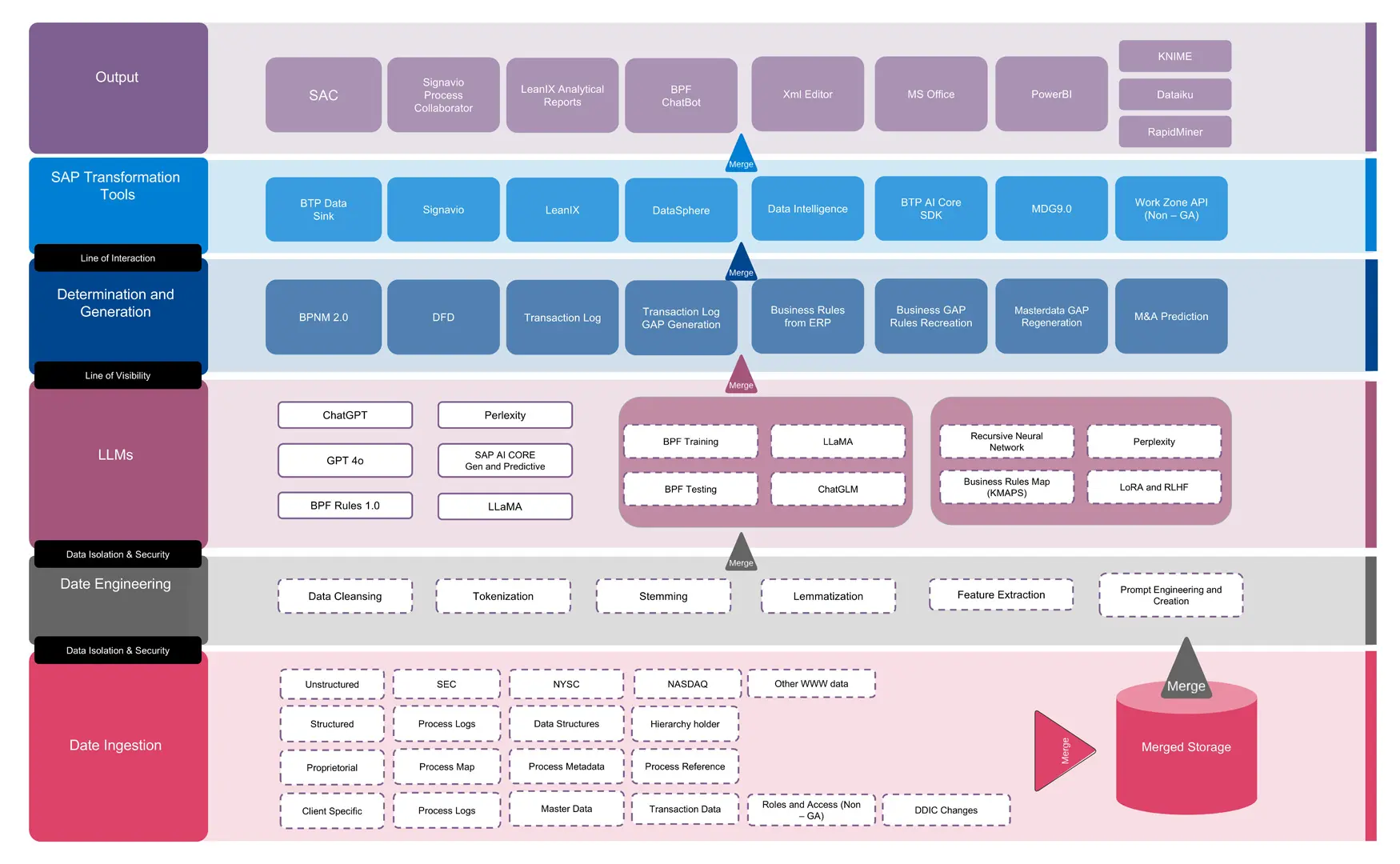
Click on the infographic to zoom and pan
Business Process Fabric’s AI Co-Pilot leverages advanced AI algorithms, LLM process mining and automated process conversion schemes to deliver SAP industry-standard best practices. At its core, the model uses Generative-AI-backed augmented process mining to create interactive, detailed diagrams of operations, highlighting critical process interdependencies and enabling seamless process redesign and improvement. Key features include:
- Leveraging neural networks to seamlessly connect SAP and non-SAP systems.
- Using the Synthetic Process Generator to create visual representations of business processes.
- Enabling AI-driven predictive models to forecast and benchmark key process steps.
- Utilizing the Smart KPI Analyzer to provide data insights across the enterprise, including real-time process latency.
- Employing LLAMA to document future-state process outcomes and map them to the IT system landscape.
- Unlocking augmented cognitive engines to predict and recommend transformative initiatives.
- Integrating the “Digital Twin” simulator to redesign and optimize processes, allowing businesses to test and validate models before full implementation.
Moreover, the architecture combines these capabilities with SAP’s market-leading process transformation tools including:
- SAP LeanIX to optimize enterprise architecture management (EAM) with strategic portfolio insights.
- SAP Signavio leverages process intelligence to enhance customer experience and drive operational efficiency.
- SAP Datasphere to unify data from SAP and non-SAP systems, ensuring governance, integration, and flexibility.
This comprehensive approach helps businesses achieve streamlined, data-driven transformation, ensuring both agility and precision.
The Example
Consider a telecommunications company undergoing digital transformation in response to the widespread adoption of 5G technology. Deterministic AI predicts significant shifts in customer usage patterns, infrastructure needs, and competitive pressures, highlighting potential risks in the company’s current business model.
Once the impending changes are identified, generative AI develops a comprehensive business transformation roadmap, suggesting:
- The redesign of service packages to cater to new customer segments
- Infrastructure investments that prioritize high-demand regions for 5G rollout
- Optimization of marketing strategies to capture early adopters of 5G technology
- Strategic partnerships with cloud providers to offer bundled services
By combining deterministic AI’s ability to predict technological shifts and generative AI’s capacity to generate transformation strategies, the telecommunications company successfully adapts to the evolving market landscape while staying ahead of the competition.
Learn more about the step-by-step approach to deploy Business Process Fabric™ for end-to-end transformation in this blog!
Conclusion: A Symbiotic Approach to Business Transformation
Cognitus’ Business Process Fabric™ leverages the combined power of Deterministic AI and Generative AI to deliver end-to-end business transformation. While deterministic AI helps businesses anticipate disruptions, generative AI creates strategic responses, allowing organizations to not only survive but thrive in the face of change.
By adopting this dual AI approach, businesses can confidently navigate uncertainty, build resilient transformation roadmaps, and emerge stronger and more agile, ready to tackle future challenges head-on.
Want to learn more? Join us at the SAP transformation Excellence Summit on September 16 in Chicago! Attend a Fireside Chat by the senior leadership of SAP and Cognitus on “Shaping Tomorrow’s Business with SAP Business Transformation Management” where we discuss the latest tools and AI-driven models that are driving the future of business transformation.